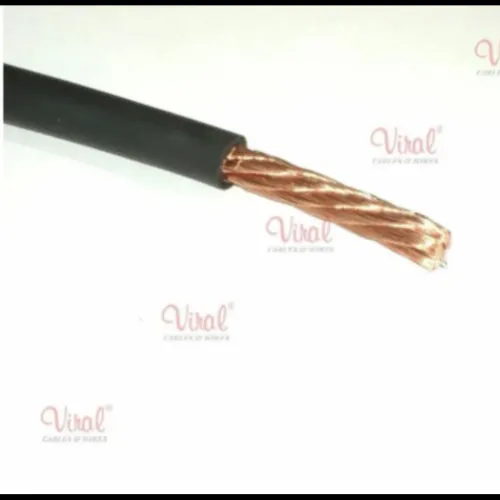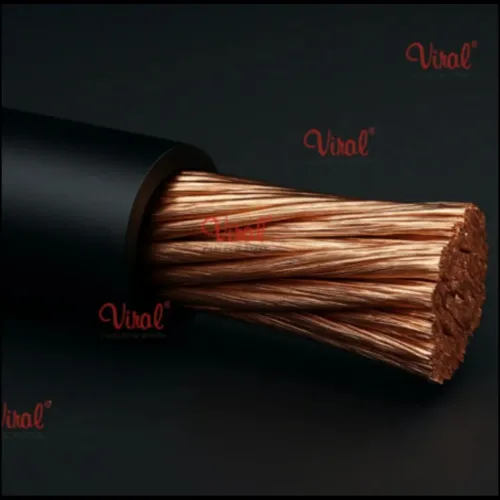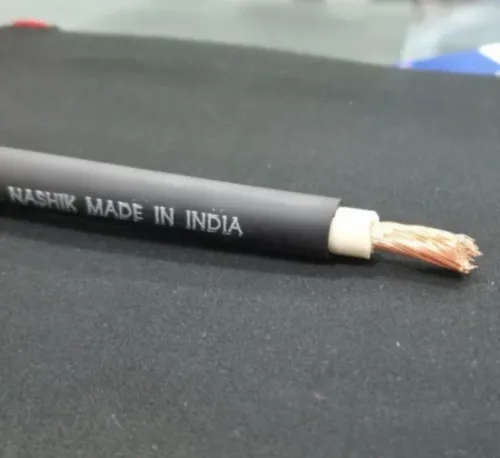

A cable’s nominal square-millimetre size does not tell you whether it will deliver the required voltage at the load, survive its environment, or accept the intended terminal. You will be able to calculate the required size, compare common options, check flexibility and routing, specify compatible terminations, and verify the delivered cable before installation.
Key takeaways
- Calculate voltage drop using the full positive and negative cable length.
- Choose 6, 25, or 95 sq mm from load, length, and allowable drop.
- Confirm superflex construction suits tight bends, vibration, and repeated movement.
- Match cable size with terminals, fuses, routing, temperature, and insulation requirements.
Calculate the cable size from current, length, and voltage drop
A single-core battery cable is electrically large enough only when it passes both voltage-drop and current-capacity checks. Calculate the drop across the complete circuit, not the positive cable alone: positive one-way length plus negative return length, multiplied by current and the cable’s actual resistance at operating temperature.
Use this method:
- Measure the one-way distance from the battery to the load, then double it for the loop length.
- Calculate voltage drop with: Vdrop = current × resistance per kilometre × loop length ÷ 1,000.
- Compare the result with your permitted drop, stated in volts or as a percentage of system voltage.
- Check continuous current, peak current, ambient temperature, bundling, enclosure, and duty cycle against the manufacturer’s ampacity data.
For example, a 10 m one-way circuit using 6 sq mm cable has a 20 m loop.
At 20 °C, a Class 5 maximum resistance of 3.30 Ω/km gives about 0.066 Ω loop resistance; 100 A would therefore lose about 6.6 V. That is unacceptable on a 12 V feed, even if the short-duration current appears manageable.
Copper resistance rises as the cable heats, so catalogue figures at 20 °C can understate real loss in an engine bay or enclosed battery box. Request single core battery cable details showing maximum DC resistance at a stated temperature, insulation temperature rating, and allowable current.
“Superflex” alone does not prove adequacy; compare measured resistance for single core cables before choosing the nominal size.
Compare 6 sq mm, 25 sq mm, and 95 sq mm against the real load
A cable size is suitable only when its continuous and peak current, total circuit length, and allowable voltage drop agree. A short 6 sq mm superflex battery cable can suit a control circuit or auxiliary battery, but a long, high-current feed can fail the voltage-drop test before it reaches its thermal limit.
| Size | Commonly suitable | When voltage drop rules it out |
|---|---|---|
| 6 sq mm | Short control, sensor, charging, or auxiliary-battery connections with modest current | A 10 m one-way run creates a 20 m loop; at 100 A, 6 sq mm copper with 3.30 Ω/km resistance drops about 6.6 V at 20 °C |
| 25 sq mm | Medium-current battery feeds for compact machinery, motors, and shorter inverter connections | Reject it when the loop length, starting surge, or allowable drop produces an unacceptable terminal voltage |
| 95 sq mm | High-current feeds to inverters, starters, contactors, and industrial battery systems, particularly on short routes | It still fails on a long route or very high load if its calculated drop exceeds the system limit |
Calculate the loop using the positive and negative paths together, not the one-way distance. A 12 V system has little tolerance: a 0.6 V limit is already 5% of supply voltage. A 24 V system permits more absolute drop at the same percentage.
Use resistance at the expected conductor temperature, not only the 20 °C catalogue value. Copper resistance rises in an engine compartment or enclosed battery box, so specify resistance, insulation temperature rating, and duty cycle alongside the nominal area.
A “25 sq mm superflex battery cable” or “95 sq mm superflex battery cable” is incomplete without those figures.
Check what superflex construction changes in the installation
Class 5 or Class 6 strands change how the cable behaves around tight routes, terminals, and vibration. Class 5 uses flexible stranded construction; Class 6 uses finer strands for greater flexibility. “Superflex” is not an IEC ampacity class, so request the strand diameter, strand count, lay, DC resistance, finished outside diameter, and minimum bend radius.
| Construction | Practical effect | Installation consequence |
|---|---|---|
| Class 5 | Flexible, with fewer or larger strands | Suitable for ordinary routed battery connections with controlled bends |
| Class 6 | More flexible, with finer strands | Better for tight spaces, repeated movement, and vibration, but requires compatible terminals and crimp tooling |
A catalogue bend radius is not permission to fold the cable behind a lug. Sharp bending at the barrel, unsupported weight, or rubbing against a chassis edge can break strands and loosen the termination. Route positive and negative single-core conductors with separate abrasion protection, support, and strain relief.
Check these points before treating a cable as suitable:
- Measure the route, including the space needed for grommets, conduit, loom, bend control, and support clips.
- Confirm that the cable’s minimum bend radius applies during installation and operation, not only during fixed routing.
- Compare the cable outside diameter with the lug barrel, grommet, conduit, and available clearance.
- Do not substitute welding cable automatically. Confirm oil, fuel, moisture, abrasion, flame, chemical, and heat requirements; SAE J1127 applies only to specified low-voltage battery cables.
- Where a busbar replaces part of the run, recalculate each remaining cable length and terminal arrangement.
- For a 6 sq mm, 25 sq mm, or 95 sq mm cable, request maximum DC resistance at 20 °C rather than relying on “superflex” or strand count.
Match the cable to terminals, protection, and the installation environment
A correctly sized cable can still fail at its termination. Match the cable’s finished outside diameter to the lug barrel, then confirm the palm, stud hole, and barrel length fit the battery post or contactor. A 95 sq mm conductor does not guarantee a compatible terminal.
Use the lug manufacturer’s specified strip length, die, crimp position, and inspection method. A hex crimp usually gives controlled compression; use a hammer crimp only when the lug manufacturer approves that tool. Do not rely on solder alone: solder wicks into fine strands and creates a rigid fatigue point behind the lug.
Before approving the assembly, verify:
- The lug is rated for the conductor’s strand class and material, with no loose strands, cracked barrel, or under-crimped section.
- Battery fuse protection is installed close to the positive source, with an interrupt rating and continuous-current rating suited to the system.
- A grommet protects every chassis pass-through; add conduit or loom where abrasion, heat, or movement threatens the insulation.
- Support the cable before the lug and control the bend so the cable does not flex sharply at the barrel.
- Check the lowest temperature rating among the cable, lug, fuse holder, connector, and equipment terminal. Account for ambient heat, grouping, and enclosure ventilation.
- Specify bare or tinned copper. Use sealing and corrosion-resistant hardware for wet or salty routes; tinning does not fix trapped water.
Inspect the completed route with the cable installed, not merely on a bench. A heavy lug can pull the conductor sideways, while a tight chassis edge can damage insulation after vibration begins.
Reconcile the specification before you order or cut the cable
A cable is not confirmed by its nominal square-millimetre label alone. Reconcile your calculation with the supplier’s datasheet, conformity document, and batch test report before ordering or cutting.
Request these details for the exact delivered construction:
- Nominal cross-sectional area, conductor Class 5 or Class 6, strand diameter, strand count, finished outside diameter, and minimum bend radius
- Maximum cable resistance at 20°C, with the test method and length stated
- Insulation temperature rating and the applicable standards, including IEC 60228 and IS 8130:1984
- Batch or reel number, manufacturing length, and a certificate linking those details to the test results
- Lug barrel dimensions, terminal stud hole, crimp-tool requirement, and compatibility with the cable’s strand class
Use the stated cable resistance in your voltage-drop calculation. Multiply it by the complete positive-and-negative route; then allow for copper resistance rising above 20°C inside an engine compartment or enclosed battery box. A supplier who gives only “superflex,” strand count, or outside diameter has not proved the conductor is electrically adequate.
Check the delivered reel before cutting:
| Check | Accept | Reject |
|---|---|---|
| Resistance | Guaranteed maximum at a defined temperature | “Low resistance” without a figure |
| Construction | Matches the ordered class, strands, and area | Substituted class or unexplained size |
| Identity | Reel, batch, and certificate agree | Missing or conflicting records |
Viral Electronics PVT LTD / Viral Electronics LLP can be asked for this evidence against the quoted cable specification, not merely the product name. A short resistance test and outside-diameter measurement can expose a wrong or copper-clad-aluminium delivery before installation.
Related products
 | Battery Cables 16 Sq mm Single Core Superflex Battery Cables Product Details: Conductor Material: Copper Standard: IS 8130:1984 Maximum Withstand Temperature: 90°C Nominal Conductor Cross-Section: 50 sq. View product → |
 | Battery Cables 25 Sq mm Single Core Superflex Battery Cables Product Details: Conductor Material: Copper Core Type: Single Core Class: 6 (Superflex) Standard: IS 8130:1984 Maximum Withstand Temperature: 90°C... View product → |
Frequently asked questions
How do you calculate voltage drop for a single-core battery cable?
Add the positive one-way length to the negative return length, then calculate the drop from current, cable resistance, and operating temperature. Check the complete circuit rather than the positive cable alone.
How do 6 sq mm, 25 sq mm, and 95 sq mm cables differ?
Compare each size with the real load, total circuit length, allowable voltage drop, installation temperature, and current-carrying capacity. A larger cross-sectional area reduces resistance but requires larger terminals, protection, and routing space.
What does superflex construction change during installation?
A superflex cable is designed for easier bending and movement than a rigid conductor of the same nominal area. Check its minimum bend radius, bending frequency, support points, and whether vibration or repeated flexing is part of the installation.
What must you match before installing a single-core battery cable?
Match the cable to terminal and lug dimensions, fuse or circuit-breaker rating, insulation temperature rating, routing method, abrasion protection, ambient heat, moisture, chemicals, and movement.
What should you reconcile before ordering or cutting cable?
Confirm conductor area, strand and insulation specification, voltage rating, temperature range, colour or polarity identification, total cut length, terminal compatibility, protection rating, and the required cable standard or test documentation.
Related products
 | Battery Cables 6 Sq mm Single Core Superflex Battery Cables Product Details: Conductor Material: Copper Standard: IS 8130:1984 Maximum Withstand Temperature: 90°C Nominal Conductor Cross-Section: 70 sq. View product → |
 | Battery Cables 10 Sq mm Single Core Superflex Battery Cables Product Details: Conductor Material: Copper Number of Cores: Single Core Maximum Size: 95 sq. mm Nominal Conductor Cross-Section: 95 sq. View product → |
 | Battery Cables 95 Sq mm Single Core Superflex Battery Cables Product Details: Conductor Material: Copper Standard: IS 8130:1984 Maximum Withstand Temperature: 90°C Nominal Conductor Cross-Section: 95 sq. View product → |
 | Battery Cables 70 sq mm Single Core Standard Battery Cables Product Details: Conductor Material: Copper Length: 100 meters Maximum Withstand Temperature: 90°C Nominal Conductor Cross-Section: 70 sq. View product → |