
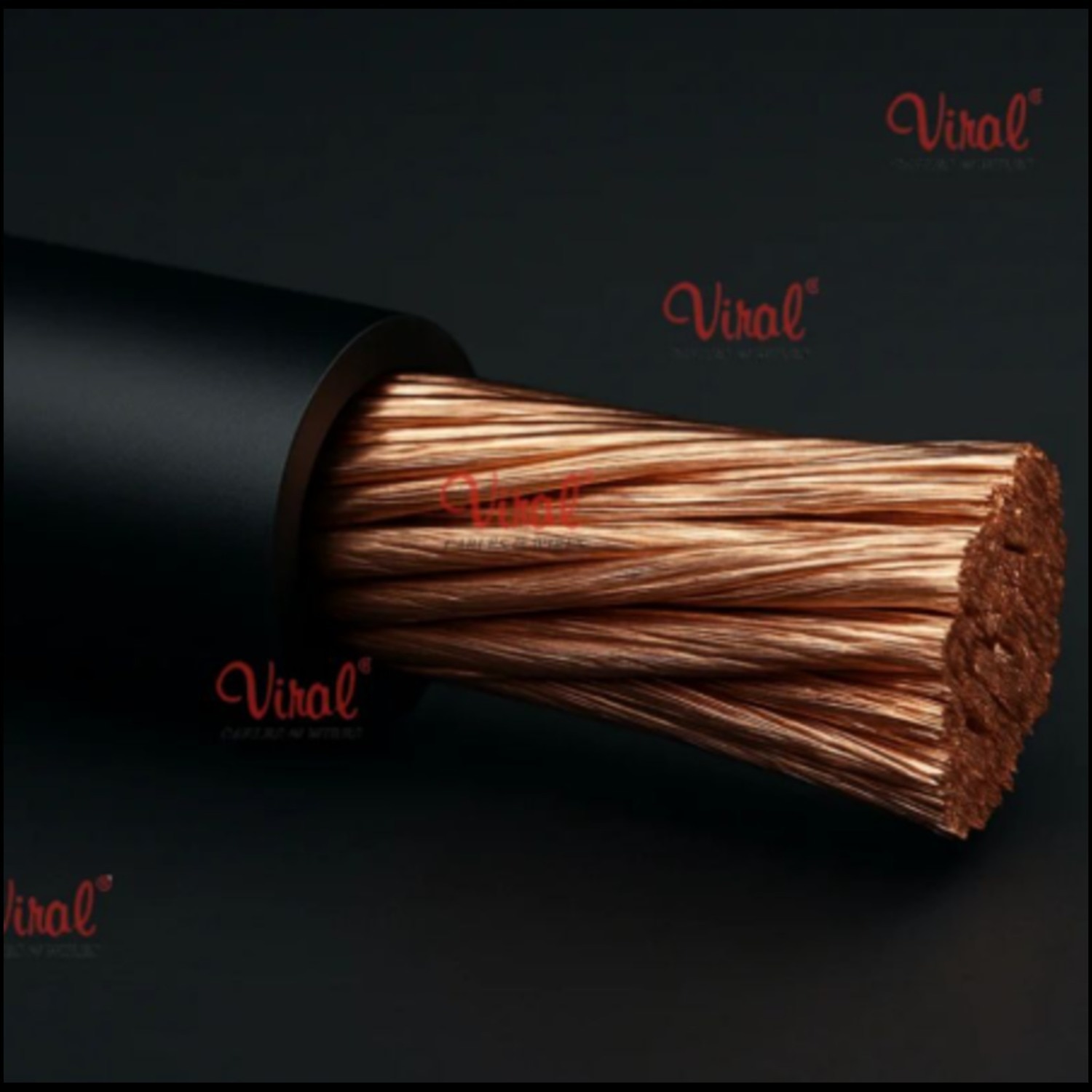
A 16 sq. mm cable and a 70 sq. mm cable do not differ only in price: conductor area changes resistance, voltage drop, mass, flexibility, and handling demands. By the end, you will be able to compare 25 sq. mm welding cable and 35 sq. mm welding cable, calculate the complete circuit requirement, and decide when 50 or 70 sq. mm is justified.
Key takeaways
- Choose 35 sq. mm for a balanced general-purpose option.
- Do not assign safe current from square-millimetre size alone.
- Select 70 sq. mm for higher current or longer welding leads.
- Specify conductor, insulation, flexibility, length, duty cycle, and testing.
How 16 to 70 sq. mm welding cables compare in practice
For industrial welding cable sizes, 35 sq. mm usually offers the best balance for general equipment: substantially lower resistance than 25 sq. mm without the mass and handling penalty of 50 or 70 sq. mm. The figures below compare copper conductors, not universal safe-ampere ratings.
| Size | Resistance at 20°C | Conductor mass | Voltage drop at 200 A: 20 m / 50 m / 100 m |
|---|---|---|---|
| 16 sq. mm | 0.00109 ohm/m | 0.143 kg/m | 4.36 V / 10.90 V / 21.80 V |
| 25 sq. mm | 0.00070 ohm/m | 0.224 kg/m | 2.80 V / 7.00 V / 14.00 V |
| 35 sq. mm | 0.00050 ohm/m | 0.314 kg/m | 2.00 V / 5.00 V / 10.00 V |
| 50 sq. mm | 0.00035 ohm/m | 0.448 kg/m | 1.40 V / 3.50 V / 7.00 V |
| 70 sq. mm | 0.00025 ohm/m | 0.627 kg/m | 1.00 V / 2.50 V / 5.00 V |
Each voltage-drop length is the complete circuit: electrode lead plus work-return lead. Connector resistance is excluded, and resistance rises as copper heats, so sustained welding produces more drop.
The 16 sq. mm option is the lightest and most flexible, suited to short, intermittent work. The 25 and 35 sq. mm sizes are practical general-purpose ranges; 35 sq. mm is often the strongest compromise. The 50 and 70 sq.
mm choices become progressively heavier but suit long, high-current, or high-duty circuits where lower drop matters more than easy handling.
What determines safe current beyond the cable’s square-millimetre size
A cable’s square-millimetre area is only one input: safe current depends on heat removal, voltage drop, and how long the load stays on. The required inputs for welding cables for industrial equipment are:
- welding current and duty cycle
- electrode-lead length, work-return length, and total circuit length
- ambient temperature, bundling, and airflow
- connector temperature
- continuous versus intermittent loading
Duty cycle describes the test period, not a cable’s permanent current limit. At 60%, the equipment operates for 6 minutes in a 10-minute test period, followed by cooling time. At 100%, it operates continuously for the stated test conditions.
| Rating | Practical meaning | Why it is not directly comparable |
|---|---|---|
| 125 A at 100% | 125 A continuously under stated conditions | No cooling interval |
| 125 A at 80% | 125 A for 8 minutes per 10 | Different heating exposure |
| 125 A at 60% | 125 A for 6 minutes per 10 | More cooling time |
Do not compare a 125 A, 100% rating with a 60% or 80% rating until the test method, conductor-temperature limit, ambient temperature, and cooling arrangement match. Industrial welding cable sizes have no universal ampere rating.
For preliminary sizing, voltage drop equals current multiplied by resistance per metre and complete circuit length. Using copper resistivity of about 0.0175 Ω·mm²/m at 20°C, 25 mm² copper is about 0.00070 Ω/m. Copper at 60°C has about 16% higher resistance, before connector losses.
When 25, 35, 50, or 70 sq. mm is the better choice
At 200 A, a 50 m complete circuit produces about 7 V of copper voltage drop with 25 sq mm copper and about 5 V with 35 sq mm copper. These figures exclude connector resistance and temperature rise, so sustained welding increases the actual drop.
1. Choose 25 sq mm welding cable when the route is short, open to airflow, and within the cable and machine duty-cycle limits. Use it only when the calculated voltage drop remains acceptable; its lower mass also reduces bend force and connector load.
2. Choose 35 sq mm welding cable for the same current over a longer route, a tighter voltage-drop limit, a higher duty cycle, or extra thermal margin. The added copper earns its mass when the 25 sq mm option runs hotter or leaves too little voltage at the arc.
3. Choose 50 or 70 sq mm for long runs, high-current continuous work, grouped welding cables for industrial equipment, elevated ambient temperature, or a specified low-voltage-drop limit. A larger conductor offsets resistance that cannot be removed by better ventilation alone.
4. Size the electrode lead and work-return lead separately. A smaller or longer return lead can become the circuit’s hottest section and create most of its voltage drop, even when the visible electrode lead is large enough.
Use the smallest compliant size that meets current, duty cycle, route, temperature, installation, and voltage-drop requirements. Oversizing improves margin but adds weight, storage volume, bend force, and mechanical load on couplers.
Why copper welding cable is not interchangeable with every flexible cable
A copper welding cable is not interchangeable with another flexible cable just because its conductor area matches. At the same area, copper has lower resistance; aluminium weighs less, but needs a larger area for equivalent resistance and demands different terminations and cleaner joint preparation.
| Option | Compare before substituting | Main risk |
|---|---|---|
| Aluminium cable | Equivalent resistance, enlarged conductor area, compatible lugs, oxide control and torque | A poorly prepared joint overheats |
| Battery cable | Flexibility, strand construction, insulation, temperature and welding-service specification | Flexibility alone does not prove arc-welding suitability |
| Permanent-installation flexible power cable | Bend radius, repeated movement, abrasion protection and thermal rating | It may tolerate installation movement, not dragged leads |
| Building wire | Movement, insulation, mechanical protection and temperature conditions | PVC insulation and solid or coarse strands can fail under handling |
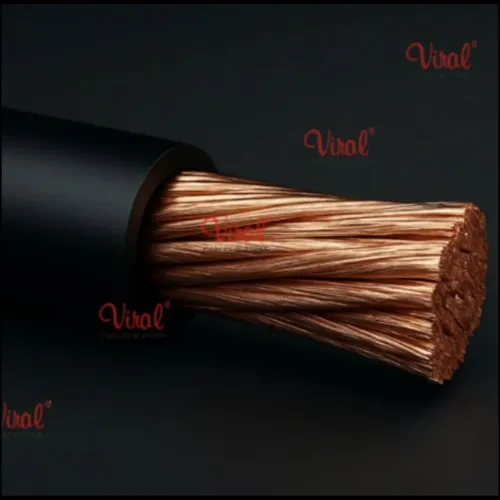
Welding cables for industrial equipment need fine-stranded construction, repeated-bending flexibility, a suitable bend radius, abrasion-resistant insulation and heat tolerance. Protect the lead from oil, chemicals, sharp edges, hot workpieces and vehicle traffic; routing damage can end its service sooner than a conductor-size decision.
Ordinary PVC building wire is a poor substitute for repeatedly dragged leads unless the installation explicitly controls movement, mechanical protection and temperature. A battery cable can be flexible without being designed for arc-welding service.
For rubber-insulated arc-welding equipment cables, check IEC 60245-6. The words copper welding cable alone prove neither flexibility, insulation performance, temperature capability nor compliance.
How to verify the installed cable and write a purchase specification
A cable matches the equipment only when its marking and installation conditions match the machine’s current, duty cycle, temperature, and circuit length. Do not approve it from a catalogue title or outside diameter.
1. Read the jacket marking and record the conductor area in mm², insulation or sheath compound, voltage rating, maximum conductor temperature, applicable standard, manufacturer, and batch or traceability number. A 25 sq mm welding cable is not the same as 4 AWG at 21.15 mm²; 2 AWG is 33.62 mm².
2. Reject outside diameter as proof of size. Strand construction, insulation thickness, and jacket material change the measured diameter, so specify the marked copper area for industrial welding cable sizes.
3. Inspect the crimped terminal lug, contact surface, coupler, strain relief, and return connection. A loose, poorly crimped, corroded, or contaminated joint can become hotter than the cable and damage insulation.
4. Write both electrode-lead and work-return lengths, welding current, required duty cycle, maximum ambient temperature, allowable voltage drop, installation arrangement, and protection against dragging, sharp edges, vehicle traffic, and repeated bending. State whether cables are bundled and whether loading is continuous.
Give Viral Electronics PVT LTD / Viral Electronics LLP the marked conductor area and applicable cable standard when requesting a 35 sq mm welding cable or 25 sq mm welding cable; do not accept an outside-diameter measurement or approximate AWG description as the purchase specification.
Related products
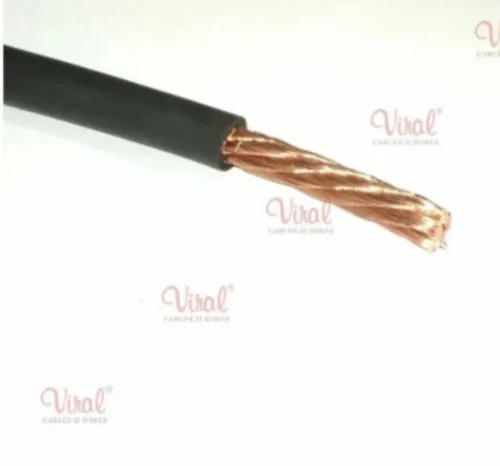
 | Welding Cables Product Details: Cable Size: 25 sq. mm Conductor Material: Copper Insulation Material: Thermoplastic Rubber (TPR) Brand: Viral Cables & Wires Ambient... View product → |
 | Welding Cables Product Details: Cable Size: 35 sq. mm Number of Cores: Single Core Conductor Material: Copper Nominal Cross-Sectional Area: 35 sq. View product → |
Frequently asked questions
How do 16 to 70 sq. mm welding cables compare in practice?
Smaller cables are lighter and easier to handle but have higher resistance. Larger cables reduce voltage drop and heating while adding weight, cost, and handling effort.
What determines safe current beyond cable size?
Check cable length, duty cycle, ambient temperature, installation conditions, conductor material, insulation temperature rating, and the welding current waveform.
When is 25, 35, 50, or 70 sq. mm welding cable the better choice?
Use 25 sq. mm for lighter, shorter-duty applications; 35 sq. mm for balanced general equipment; 50 sq. mm for higher current or longer leads; and 70 sq. mm when voltage drop and heat demand a larger conductor.
Why is copper welding cable not interchangeable with every flexible cable?
Welding cable is designed for repeated flexing, high current, and the heat and abrasion found around welding equipment. A general flexible cable may have different insulation, flexibility, voltage, and duty limits.
How do you verify an installed cable and write a purchase specification?
Record the conductor material and cross-sectional area, cable standard, insulation type and temperature rating, length, current duty, flexibility, jacket colour, termination requirements, and required test documents.
Related products
 | Welding Cables 16 Sq mm Electrode Welding Cable Product Details: Nominal Conductor Cross-Section: 120 sq. mm Ambient Air Temperature: 30°C Standards Compliance: IS 8130:1984 Nominal Covering... View product → |
 | Welding Cables Double Insulated Welding Cable 25mm Product Details: Cable Size: 25 sq. mm Conductor Material: Copper Cable Grade: Welding Cable Voltage Rating: Up to 100 V Insulation Material: Rubber... View product → |
 | Welding Cables Product Details: Ambient Air Temperature: 30°C Cooling Type: Air-cooled Duty Cycle: 60% Maximum Conductor Temperature: 60°C Available Sizes: 16 sq. View product → |
 | Welding Cables Product Details: Cable Size: 16 sq. mm Brand: Viral Ambient Air Temperature: 30°C Cooling Type: Air-cooled Duty Cycle: 60% Maximum Conductor... View product → |