
A 1 sq mm conductor can fail because of excessive heat, a poor terminal, moisture, mechanical damage, voltage drop, or protection that does not match the installation. By the end, you will be able to separate cable faults from installation faults and specify a safer replacement using load, route, length, temperature, and breaker data.
Key takeaways
- Treat 10–13 A as a reference, not a universal 1 sq mm rating.
- Compare cable heating with loose, oxidised or undersized terminal faults.
- Upsize the cable when voltage drop exceeds your equipment’s limit.
- Match conductor class, insulation rating, installation method and protective device.
What current can a 1 sq mm cable actually carry?
A 1 sq mm copper single-core cable has no universal safe-current figure. Under common 70°C PVC reference conditions, published tables often place it near 10–13 A, but that range is not a blanket rating. Confirm the cable’s product standard, conductor class, insulation temperature and installation method.
Free air removes heat best. Conduit and trunking reduce heat dissipation, while multiple continuously loaded circuits in one enclosure reduce the permissible current further. A hot roof void, plant room or crowded Mumbai conduit needs ambient-temperature correction. Thermal insulation around the cable restricts heat escape.
Intermittent duty changes heating, but size continuous loads and motor starting current separately.
- Use the manufacturer’s ampacity table for the exact cable.
- Apply ambient, grouping, enclosure and thermal-insulation correction factors.
- Check voltage drop, especially on long runs or machinery circuits.
- Select the breaker from the cable’s corrected capacity, not just appliance current.
- Treat “heavy duty” as a description, not a higher rating for 1 sq mm copper.
A breaker must also interrupt the prospective short-circuit current. Loose terminals, wet joints, crowded conduits and an oversized breaker can cause failure despite sound copper. This explains single core cable overheating in mumbai: inspect installation conditions and protection before replacing the cable like-for-like.
How can you tell cable overheating from a connection fault?
A cable that is hot along its full length points to overload; heat concentrated at one joint points to contact resistance. This distinction matters in a heavy duty wire failure because replacing the 1 sq mm conductor will not cure a loose terminal, wet joint, or oversized breaker.
| Fault | Inspection signs | Confirm with |
|---|---|---|
| Overloaded conductor | Warm or browned PVC along much of the run; softened, deformed, brittle insulation; burnt smell | Measure load current and compare it with the cable’s corrected capacity after conduit, grouping, ambient temperature, and duty cycle |
| Short circuit | Localised blackening, melted insulation, carbon tracking, copper spatter, or an immediately tripped protective device | Isolate the circuit and test insulation resistance and fault continuity before re-energising |
| Loose terminal | Heat, browning, melting, or a burnt smell at one screw, lug, ferrule, or partly inserted conductor; the cable length stays normal | Check torque, conductor insertion, crimp quality, and terminal size |
| High contact resistance | A sharply hot or discoloured contact surface without equivalent heating along the cable; pitted or contaminated metal | Inspect the mating surfaces and measure voltage drop across the connection under load |
| Damaged insulation | Cuts, blisters, cracks, moisture marks, corrosion, or exposed strands | Perform an insulation-resistance test; continuity alone can miss leakage |
| Incorrect protective device | Breaker rating exceeds the cable’s corrected capacity, or its interrupting rating is below the prospective fault current | Compare device rating, trip characteristics, and breaking capacity with the installation design |
Water entering through an open conduit, gland, or junction box lowers insulation resistance and corrodes terminals. Isolate power before inspection; do not touch a softened conductor or reset a repeatedly tripping breaker.
Why do flexible strands and terminals fail first?
Flexible strands and terminals fail first because they experience mechanical stress and concentrated electrical heating. Many 1 sq mm flexible cable problems begin where the conductor enters a terminal, gland, plug, or equipment housing.
Cutting strands reduces the copper area; splaying leaves some strands outside the clamp. A tight bend below the manufacturer’s minimum radius breaks strands over time. Pulling the cable instead of its strain relief accelerates the damage.
Flexibility itself does not reduce ampacity, but a Class 5 conductor can have higher resistance than some Class 2 conductors of the same nominal area.
- A poor crimp, partly inserted conductor, contaminated contact, or loose screw creates high contact resistance. Heat then concentrates at the joint, so the terminal browns or melts while the cable length looks normal.
- Use a ferrule when the terminal is designed for one, and select the correct lug or clamp for the conductor. Twisting loose strands together does not provide a dependable termination.
- Repeated movement enlarges gaps and loosens connections. Use strain relief and keep the cable within its specified bend radius.
Water entering through damaged insulation, an unsealed gland, an open conduit, or a poorly protected junction box corrodes copper and terminals and lowers insulation resistance. A continuity test can still pass while leakage remains. Disconnect power, inspect for green corrosion, darkened copper, brittle insulation, and moisture, then perform an insulation-resistance test.
When does voltage drop make 1 sq mm the wrong size?
A 1 sq mm conductor becomes the wrong size when its loop resistance causes excessive voltage drop, even though its current remains below the thermal limit.
At 20 °C, IEC 60228 lists maximum resistance of about 18.1 Ω/km for Class 2 copper and 19.5 Ω/km for Class 5; the outgoing and returning conductors roughly double the one-way distance. Calculate voltage drop as current × loop resistance, then check the equipment limit.
| Option | Voltage-drop effect | When it applies |
|---|---|---|
| 1 sq mm | Highest resistance of these choices; starting voltage falls fastest | Short lighting or control circuits, not long motors, pumps, compressors, or continuously loaded machinery |
| 1.5 sq mm | Roughly two-thirds the resistance of 1 sq mm for comparable copper construction | Moderate runs where 1 sq mm is thermally adequate but equipment performance needs more voltage margin |
| 2.5 sq mm | Roughly 40% of 1 sq mm resistance | Longer panel feeds, machinery circuits, motor starting, and higher-duty loads |
| Multicore cable | Voltage drop depends on each core’s size, length, conductor class, grouping, and unused or loaded cores | Control and machinery wiring; do not assume the sheath makes a smaller conductor adequate |
| Larger single-core | Lowest resistance and stronger voltage stability at the same current | Long runs, high-inrush motors, panels, and high-duty feeders |
A motor can trip or fail to start when its running current looks acceptable because starting current is higher. Check the full route, ambient temperature, conduit grouping, terminal connections, and allowable voltage-drop limit before selecting a larger conductor.
How should you specify the replacement and its protection?
Do not replace the failed wire until you identify whether the cause was overload, heat, moisture, or a bad joint.
A 1 sq mm heavy duty single core cable for faults in Mumbai is not specified by “heavy duty” alone; confirm its standard, conductor class, insulation rating, installation method, grouping, ambient temperature, duty cycle, and voltage-drop limit.
- Specify copper cross-section, conductor class, maximum resistance, and the corrected current-carrying capacity. Do not assume a flexible Class 5 conductor has the same resistance as Class 2.
- Confirm insulation material and temperature rating, plus compliance with the stated product standard, such as IS 694:2010 where applicable. Replace cable with softened, browned, blistered, cracked, or water-damaged insulation.
- Match the lug, ferrule, terminal size, and torque to the conductor. A terminal that is too small or loose will recreate the hot spot.
- Select the MCB or fuse below the cable’s corrected capacity, not merely above the appliance’s running current. Check its trip curve and breaking capacity against the prospective short-circuit current.
- Check glands, conduit ends, junction-box seals, and neutral connections for monsoon water ingress and corrosion.
Confirm these records before energising:
| Check | Confirm | Why it matters |
|---|---|---|
| Conductor | Class, resistance, size | Finds undersizing |
| Protection | Rating, curve, breaking capacity | Prevents delayed fault clearing |
| Tests | Continuity, polarity, insulation resistance, earth continuity, loop impedance | Continuity alone misses leakage |
| Fault level | Prospective short-circuit current | Proves the breaker can interrupt the fault |
Viral Electronics PVT LTD / Viral Electronics LLP can be asked for the conductor resistance, class, temperature rating, and test documentation rather than relying on the catalogue label.
Related product
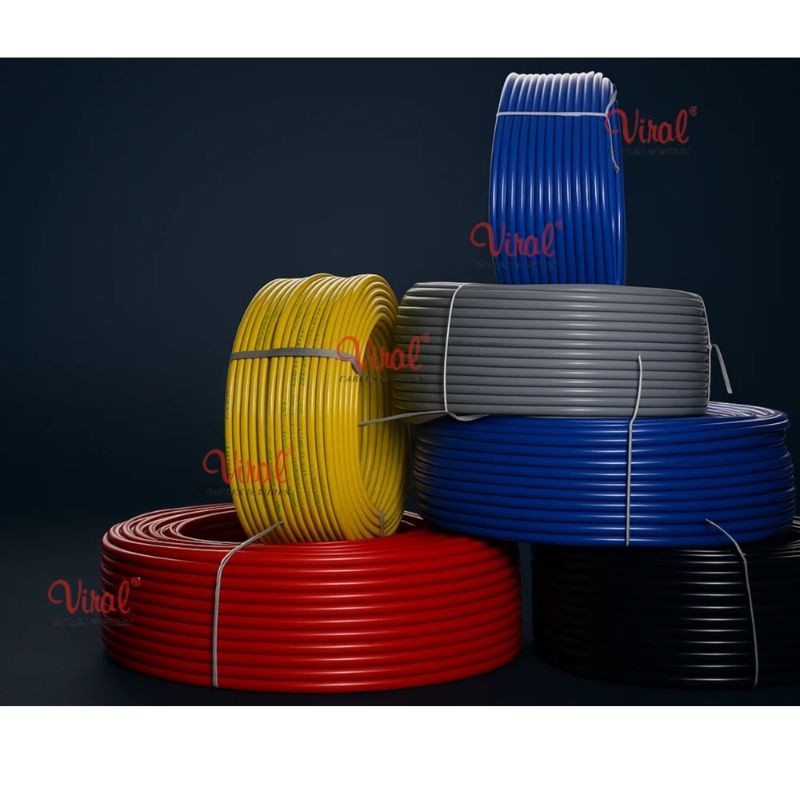 | House and Electric Panel Wires 1 Sq mm Single Core Heavy Duty Flexible Cables Conductor Type Stranded Material Copper Diameter see specification sheet Insulation Material PVC Standards IS 694/2010 Min Nominal Size 0.5 sq.mm Max... View product → |
Frequently asked questions
What current can a 1 sq mm cable carry?
Under common 70°C PVC reference conditions, published tables often place it near 10–13 A. Confirm the product standard, conductor class, insulation temperature and installation method before selecting protection.
How can you distinguish cable overheating from a connection fault?
Inspect the full cable length and each termination. Heat concentrated at a lug, screw or terminal points to a connection fault; uniform discolouration or soft insulation along the cable points to conductor overload or poor heat dissipation.
Why do flexible strands and terminals fail first?
Flexible conductors contain fine strands that need correct stripping, ferrules or lugs, and firm termination. Loose, cut or splayed strands increase contact resistance, creating local heat before the cable length overheats.
When does voltage drop make 1 sq mm the wrong size?
Calculate voltage drop from load current, one-way run length, conductor resistance and supply voltage. Choose a larger conductor when the calculated drop exceeds the equipment or circuit limit, even if ampacity is adequate.
How should you specify a replacement 1 sq mm cable?
State the conductor material and class, cross-sectional area, insulation temperature rating, product standard, flexibility, voltage rating, installation method and protective-device rating. Check the replacement against the actual load and route.